Welcome to my first tracker post of the UK economy! I intend this to be similar in format to my UK Weather Tracker except that it will be published quarterly rather than monthly. In this post I will explain the statistics I have chosen to track.
I am a big believer in placing recent statistics in their historical context. Nothing annoys me more than someone overexplaining a small dip in GDP which in historical terms is absolutely meaningless. Unfortunately we live in a world cursed by the year on year comparison without any understanding of basic time series concepts such as autocorrelation and reversion to the mean. So one hope I have with my Economy Tracker is to improve this state of affairs.
I will be tracking 8 economic variables for the UK which come in 4 pairs:-
- GDP Growth & Real Wage Growth
- Unemployment Rate & Economically Inactive Rate
- Consumer Inflation (CPI) & Retail Inflation (RPI)
- Government Borrowing & National Debt Ratio
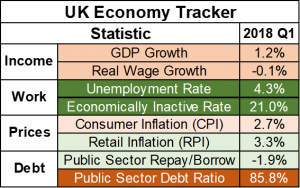
I see these as the topline summaries of a national economy. The first pair measures whether the income of a nation is growing and whether that growth is getting into the pockets of the people. The second pair measures whether we are in work or seeking work. The third pair measures whether the price we pay is going up or down. The last pair measures government borrowing and debts and thus pressure on public services that we depend on. As of Q2 2018, the top line summary is shown in the table below using a green (good) to brown (bad) traffic light system. These traffic lights are explained later in this post.
I will explain each of the 8 statistics in turn starting with GDP growth. Clicking on each heading below will take you to the ONS (Office of National Statistics) website where I sourced the data from. The 4 letter code in each heading is the ONS time series code I’ve chosen to use and on the landing page each heading sends you to, you can enter a new 4 letter code in the box at the top if you wish. Often the ONS will have variants on these time series under other codes and if you see some statistics published elsewhere, look for this 4 letter code to see if you are comparing like with like.
By the way, if you think I am not using the most appropriate time series, please do contact me and let me know!
1a – GDP Growth (IHYR)
Gross Domestic Product (GDP) is the official measure of the size of the economy i.e. how much we as a nation earn, spend and produce. This is published on a quarterly basis so it is more usual to report GDP growth i.e. by how much GDP has changed from the previous quarter. Since inflation can cause GDP to grow on its own, GDP growth is normally reported based on the Chained Volume Measure (sometimes called Constant Prices) of GDP which strips out the effect of inflation. Also, GDP is a seasonal variable so the ONS also strips out this effect from the GDP growth which results in the IHYQ seasonally adjusted (SA) time series that I could have chosen to use and is usually the headline figure in any news report.
However, if you click on the heading above, this will take you to the chart shown below which is of the IHYR series which is a rolling year on year change in GDP by quarter. I refer to this as the Annualised GDP Growth figure and is ultimately the figure of interest of economists.
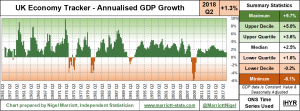
What I want my tracker to do is put the latest quarter’s figures into context. To do this, I take the entire history shown in the chart and calculate 7 statistics (listed in the chart above) which are all percentiles:-
- 100th percentile = Maximum = +9.7% (in Q1 1973)
- 90th percentile = Upper Decile = +5.0%
- 75th percentile = Upper Quartile = +3.6%
- 50th percentile = Median = +2.5%
- 25th percentile = Lower Quartile = +1.6%
- 10th percentile = Lower Decile = -0.2%
- 0th percentile = Minimum = -6.1% (in Q1 2009)
If you follow my UK Weather Tracker then you should be familiar with these percentiles as I use the same ones there. Looking at these percentiles, it is clear that 10% of the time, the UK economy is in decline and 10% of the time it is booming. But half the time, it is basically bumbling along when annualised GDP growth is between +3.6% and +1.6% per year. In other words, if the latest annualised figure is in this range, it is not remarkable in any shape or form. Q2 2018 was +1.3% which is below the lower quartile but still quite a way from the lower decile.
The 7 percentiles together generate 6 ranges e.g. +9.7% to +5.0% is the top range, -6.1% to -0.2% is the bottom range and the other 4 ranges are the gaps between successive percentiles. 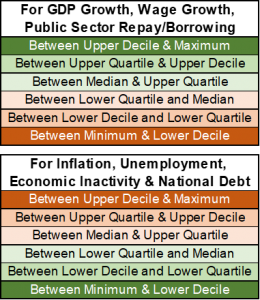 I decided to colour code these 6 ranges so that each quarter’s figure can be characterised at a glance. I’ve chosen to use a traffic light system with green for “good” and brown for “bad” but whether green is the top range or the bottom range depends on the statistic being analysed. The table here lists how each statistic is being colour coded.
For GDP growth green is the top range and brown is the bottom range but we should bear in mind that not all statistics are purely linear. The top range of GDP growth is often described as an economy overheating which can lead to a recession. That aside, I will keep this colour code for GDP growth.
One thing that is quite notable from the chart is how much more volatile GDP growth used to be in the 50s, 60s and 70s and even the 80s was quite volatile. The 90s, 00s and 10s however have been more stable overall though of course the Great Recession was a whopper in contrast to the stability otherwise. From 2008 Q3 to 2009 Q4, we had 6 consecutive bottom range quarters in a row which had not been seen since the war.
1b – Real Wage Growth (KAC3 / D7G7 )
GDP receives the lion’s share of attention but in the end, we want GDP growth to feed through to our pockets. GDP is shared between us, businesses and the government and it can be the case that the government (via taxes) and businesses reap the benefits of a growing economy but not the people. So I want to track some measure of how much is appearing in our pockets and I have chosen to use Real Wage Growth. The chart looks like this.

If you are reading about wage growth in the news, you are likely to be hearing the KAC3 figure which is currently +2.6%. This does not take inflation into account and in order to make this comparable with GDP growth (which does take inflation into account) I need an inflation to make the adjustment and I am using CPI series D7G7 which is explained below in section 3a. The formula for making the adjustment is as follows:-
Real Wage Growth = ( 1 + KAC3 ) / ( 1 + D7G7 ) – 1 where both KAC3 & D7G7 are decimals rather than percentages.
Unfortunately, the KAC3 series only started in 2001 and I really wanted a longer time series than that. The ONS used to track wage inflation using the MD9S series which ended at the start of 2000. So prior to that date, I have used MD9S instead of KAC3 and also used the RPI series CZBH rather than the CPI for inflation. The consequence is that there is a gap in 200 with no data and that the data prior to 2000 is not quite comparable to data from 2001. With that being said, I don’t think the difference is that great and I will ignore this.
Coming back to the chart above, there is quite a story here. If you look at the GDP growth chart, you can see recessions in 74/75, 80/81, 91/92 and 08/09 but the impact on the wages of those in work was quite different. The 74/75 & 08/09 recessions hit our pay slips significantly whereas the 80/81 and 91/92 recessions only had a limited impact on our payslips. As we will see in the next section, those recessions were more marked by job cuts rather than pay cuts. The 08/09 recession though stands out for the length of time that our pay slips were hit lasting for 6 years! Why this is the case is something that I don’t is yet understood and must have had a knock on effect on domestic politics.
2a – Unemployment Rate (LF2Q)
The Unemployment Rate used here is the ILO (International Labour Organisation) definition of unemployment and measures the proportion of those deemed to be Economically Active who are out of work. Again, this measure does not go all the way back to 1955 but it does cover quite a few significant decades.

This time, high values are bad and coloured brown and low values are good and coloured green. Again, we should bear in mind that the scale is not truly linear and very low unemployment such as we have at the moment can be a sign of an economy that is short of labour and hence not earning as much as it could (as measured by GDP).
Unlike GDP, unemployment is much more stable over time and the periods of high and low unemployment clearly stand out. We can also see clear difference between the 80/81 recession and the 08/09 recession. Both started with unemployment in the same place but the former saw a major rise in unemployment up to 12% that persisted for over 4 years before it finally started falling in 1987. The 91/92 recession then stopped that fall and it wasn’t until 1997 that unemployment fell back to the levels of the 1970s.
The 08/9 recession also saw an increase in unemployment but the rise was much smaller than the 1980s and the recovery was much more rapid. Unemployment today is near record lows for this particular index. As explained in section 1b above, another difference between the two recessions is that the 08/09 recession was accompanied by wage cuts whilst the 80/81 recession did not see wage cuts.
2b – Economically Inactive Rate (LF2S)
The long recovery from the high unemployment of the 1980s is well documented in British economic and political history. Many views have been put forward as to why this happened but very few avoid mentioning the prime minister of the time, Margaret Thatcher. What is agreed upon is that the economy underwent radical changes during the 1980s and the legacy of that decade has lasted for a long time. What I hadn’t appreciated until I looked into it around the time of her death in 2013 was that there was a blindingly obvious explanation for why unemployment persisted at record levels in the mid-80s and only began to fall in 1987 long after the economy had recovered from the 80/81 recession.
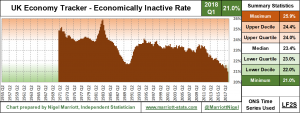
Economic Inactivity is rarely mentioned in the news and yet it is an important statistic. It measures the % of adults between the ages of 16 & 64 who are not seeking work. There are 4 main reasons why working age adults do not seek work:-
- They are in full time education.
- They are full time carers of homes, children or adults.
- They are unable to work due to long term sickness.
- They have taken early retirement.
These days. full time students are the largest proportion of economically inactive adults but back in the early 1980s when nearly 25% of working age adults were economically inactive, students were a much smaller proportion of society then and full time housewives would have been far more common. Then starting around the time when unemployment approached its peak late 1983, the economically inactive rate fell by 3 points from 25.9% to 22.9% over a 3 year period whilst the unemployment rate barely changed from 11.4% to 10.3% which is apparent from the chart above. Clearly what happened is that a considerable numbers of economically inactive adults decided to become economically active and seek work. I strongly suspect these must have been women going out to work for the first time and note this happened in a time when university education was starting to expand and increasing numbers of people became long term sick, both factors that would have countered that effect. The unemployment rate is the % of economically active adults out of work but if the numbers of economically active adults rises considerably and the number of jobs only keeps pace with this, then it is no surprise that the unemployment rate remained static for a number of years.
The fall in economic inactivity was ended with the 1991 recession whereupon it rose back to 23%. It remained static during the 90s and 00s but in the last decade, it has fallen again and in Q1 2018, it reached its lowest level on record. When you combine that with low unemployment, it speaks of an economy with record levels of employment.
3a – Consumer Price Inflation (D7G7)
There are two inflation indices reported in the press, CPI (Consumer Price Index) and RPI (Retail Price Index). Note these figures are price indices whereas inflation is the % change year on year in the price index. The Bank of England prefers to track CPI and seeks to hold inflation to within +1% to +3%. As the chart below shows, these limits are essentially the lower decile and the upper quartile.
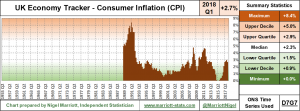
This index started in 1988 and superseded the RPI within 10 years. Unfortunately that means the 7 percentiles miss the high inflation of the 70s and potentially underestimate inflation risk.
3b – Retail Price Inflation (CZBH)
For the reason just laid out in the previous section, I have decided to track the RPI as well. The main reason is that it has greater history and gives a better picture of how inflation can vary in the UK. It must be noted though that the RPI is no longer regarded as a National Statistic i.e. the methods used to estimate RPI are not considered to be best practice any longer and many statisticians have called for its abolition.

Whereas the 80s was the decade of unemployment, the 70s was the decade of inflation. Like unemployment, it took almost 2 decades to get the economy back to a more normal footing. Unlike CPI, today RPI is back below the median RPI value.
4a – Annualised Government Repayment/Borrowing as % of GDP (J5II as % of BKTL)
The government is a major player in our economy and is funded by our taxes. So if spending outstrips tax receipts, we have a spending deficit which has to be funded usually through borrowing. Therefore tracking government borrowing tells us if the economy is likely to see spending cuts and/or tax rises. Conversely, when tax receipts exceed spending and we have a surplus, the government can use the surplus to repay existing debt, cut taxes or increase spending.
Surpluses and deficits are usually expressed as a % of GDP. Note this time, the GDP figure needs to be based on current prices i.e. without any inflation adjustment since the borrowing/repayment figures are also not adjusted for inflation. Hence the borrowing time series J5II is divided by the current GDP time series BKTL instead of IHYR used in chart 1a above. In addition, both J5II and BKTL are annualised (by taking rolling 4 quarterly totals).

Note that positive figures reflect surpluses and repayment of debt and negative figures reflect deficits and borrowing. You should notice that the median is -2.6% i.e. the government has nearly always been borrowing rather than repaying. Therefore the green colour scale is slightly misleading here as it simply refers to quarters that are above the median rather than quarters where debt was being repaid.
An examination of history here is rather disquieting. In the 50s and 60s, governments were generally running balanced budgets on average but the 70s saw the start of sustained deficits especially with the 74/75 recession. A notable difference about the 80/81 recession was that Margaret Thatcher chose not to increase spending and prioritised cutting the deficit. This makes the 80/81 recession different from the other 3 recessions where the deficit increased during the recession.
You might also notice that the last recession took a lot longer to reduce borrowing to at least above the median. This means that we are still borrowing but at a level that is usually matched by GDP growth, a point explored in the next section. The reason why it took so much longer is that Gordon Brown, when he was chancellor, decided to run a structural deficit even whilst the economy was growing. This is apparent by the period 2003 to 2007 when borrowing averaged 3% of GDP. Prior to the recessions of 74/75 and 91/92, the governments usually had a balanced budget or a surplus which meant when they borrowed money to tide over the recession, they were starting from a balanced budget. But the recession of 2008 (and 80/81 for that matter) started from a structural deficit. Clearing the additional deficit caused by the recession was complete as of 2016 (roughly the same amount of time it took to clear the deficit of 91/92) but that still left the country needing to clear Gordon Brown’s structural deficit and at current trends that is going to take another two or three years.
4b – National Debt as % of GDP (YEQG as % of BKTL)
The accumulated borrowings over history results in a national debt or more strictly the Public Sector Net Debt. This is commonly expressed as a % of GDP i.e. what is our debt as a proportion of our what we earn each year. This is shown in the next chart which is a calculation that divides series YEQG by series BKTL. This calculation is actually done by series HF6X but it doesn’t go back far enough for my purposes.

Today, public debt is at its highest since this series began and has been for quite some time. Generally, when GDP growth is larger than borrowing, then the debt ratio will fall but when borrowing is higher than GDP growth, then the debt rises rapidly as it did in the recession. We should now see a continued fall in the ratio but it will be a slow fall whilst GDP growth remains sluggish.
Summary Table
The 8 charts shown above give you a long term view of the economy and how the most recent quarter compares. The table here provides a snapshot summary with the latest figure for each statistic shown colour coded which allows us to summarise the state of the economy as follows.
We have record levels of employment and economic activity with normal levels of inflation. Public borrowing is coming under control which is not before time given the record levels of debt we have to pay off. The problem though is that our economy is not growing fast enough and what growth there is is not feeding through to our pockets. In effect, we are working hard to essentially stand still and making little progress on clearing our debts. Should another recession occur, we will end up in a situation not unlike the 1980/81 recession when the government decided it could not increase public borrowing since debt is already so high.
Previous Economy Tracker Posts
- Click here for the latest quarter
- Click here to see a list of all posts related to the UK economy
- 2019 – Q1, Q2, Q3, Q4
- 2018 – Q1, Q2, Q3, Q4
