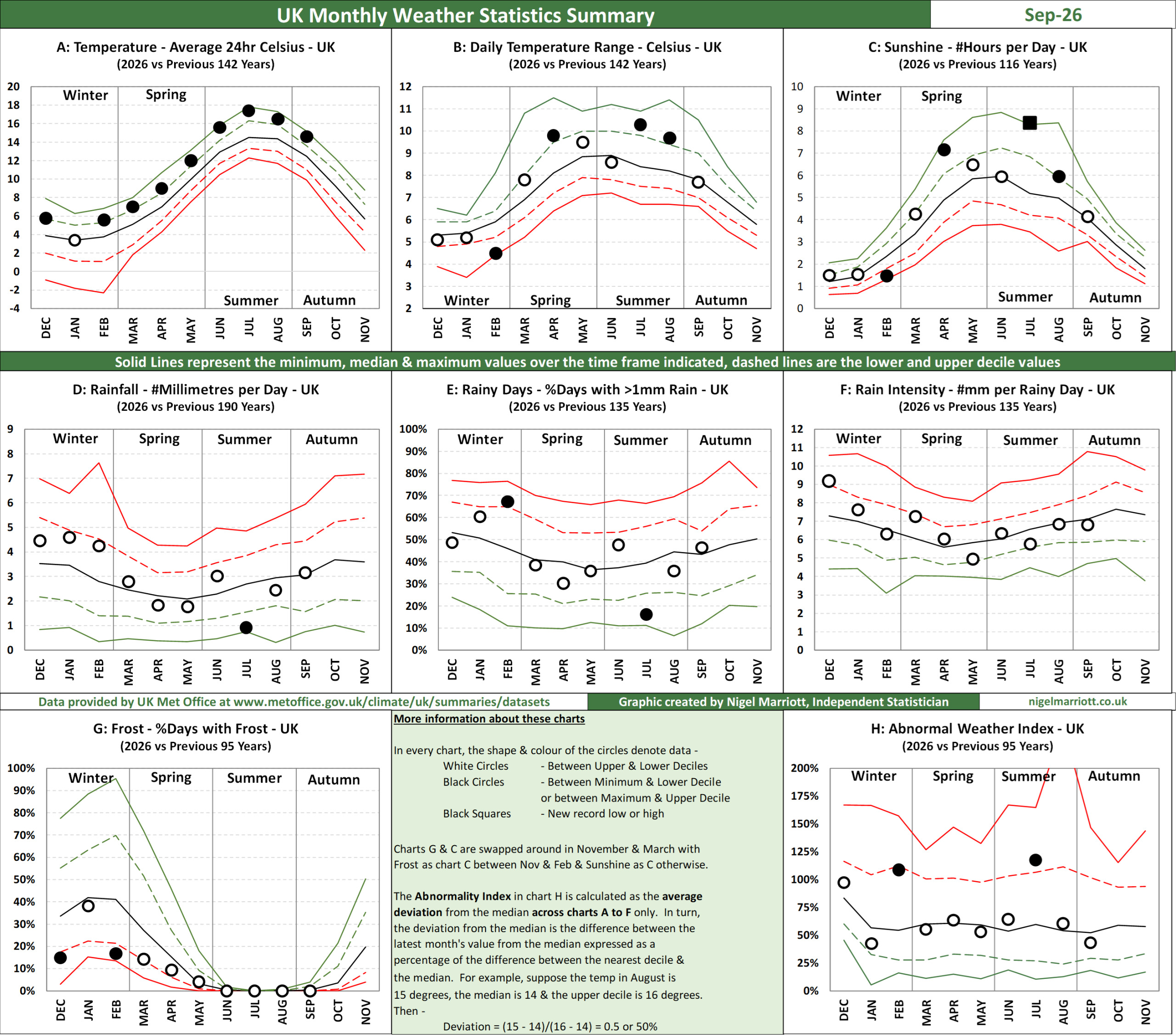
This is getting repetitive! The weather in the UK in September was the 4th warmest on record in the UK but sunshine and rainfall were completely normal. Where have I said that before? Oh right, in practically every month so far in 2026!
The Latest Month’s Weather in 8 Charts
The meteorological year starts in December which is why December appears as the 1st data point in the charts below. All data is supplied by the Met Office and can be found here. The dashboard below shows charts for 7 weather variables and a summary index as a single graphic. The middle bottom block explains why some data points are in black, points out the charts for Sunshine & Frost are swapped around according to the seasons and how the abnormality index (see next section) is calculated.
In July 2025, the Met Office extended their historical frost days data back to 1931.
How abnormal was September 2026?
Chart H displays my UK Weather Abnormality Index (see my May 2019 post for details). The closer to zero this index is, the less abnormal and thus more “average” a month is. The higher it is, the more abnormal the month is. When the index is over 100%, we can describe the month as unusual in some way.
The abnormality index was 43% this month which is in between the lower decile and the median.
PS: If you bookmark this link, it will be refreshed with the latest month’s data. I usually post the update in the first week of each month.
Click the relevant month below to see what the weather was back then. Months highlighted in bold had an abnormality index exceeding 100% indicating unusual weather. Alternatively click the Weather Tracker hash tag below this post to see a list of all such posts.
- Click here for the latest month.
- 2026 – January, February, March, April, May, June, July, August, September, October, November, December
- 2025 – January, February, March, April, May, June, July, August, September, October, November, December
- 2024 – January, February, March, April, May, June, July, August, September, October, November, December
- 2023 – January, February, March, April, May, June, July, August, September, October, November, December
- 2022 – January, February, March, April, May, June, July, August, September, October, November, December
- 2021 – January, February, March, April, May, June, July, August, September, October, November, December
- 2020 – January, February, March, April, May, June, July, August, September, October, November, December
- 2019 – January, February, March, April, May, June, July, August, September, October, November, December
- 2018 – January, February, March, April, May, June, July, August, September, October, November, December
- 2017 – January, February, March, April, May, June, July, August, September, October, November, December
For analysis of trends by seasons, please click on the relevant season from this list or the Weather Trends hashtag below this post.
- 2026 – Winter, Spring, Summer, Autumn
- 2025 – Winter, Spring, Summer, Autumn
- 2024 – Winter, Spring, Summer, Autumn
- 2023 – Winter, Spring, Summer, Autumn
- 2022 – Winter, Spring, Summer, Autumn
- 2021 – Winter, Spring, Summer, Autumn
- 2020 – Winter, Spring, Summer, Autumn
- 2019 – Winter, Spring, Summer, Autumn
- 2018 – Winter, Spring, Summer, Autumn
- 2017 – Winter, Spring, Summer, Autumn
For analysis of trends by year, please click on the relevant year from this list –
— Subscribe to my newsletter to receive more articles like this one! —-
If you would like to receive notifications from me of news, articles and offers relating to weather, please click here to go to my Newsletter Subscription page and tick the Weather category and other categories that may be of interest to you. You will be able to unsubscribe at anytime.
