Spring 2025 in the UK was both the hottest & sunniest on record as well as the 5th driest. For sunshine, 2025 was even more extraordinary than the exceptionally sunny spring in 2020 and was the result of 3 very sunny months in a row. For temperature, there was no doubt in my mind this time the data was correct unlike last year when I questioned whether spring 2024 was in fact the warmest in record. The Met Office has not corrected the record so apparently it was.
Meteorologists define spring in the UK to be the period from March to May so spring is now over and we are officially in summer.
I analyse the long term trends in the UK weather using a statistical tool known as Standardisation. This means that the 3 key variables of Temperature, Sunshine and Rainfall are recalculated so that they all have the same units, which is number of standard deviations above or below the mean. Such variables are known as Z-Scores which by definition will have a mean value of 0 and a standard deviation of 1. For more information on how I have done this, please read my post on trends in the UK summer of 2017.
Latest Z-Scores
The Z-Scores for Temperature, Sunshine and Rainfall are shown in the 3 charts below. Each chart also contains an 11-year centred moving average which gives an idea of the underlying trend.
** NEW as of Spring 2024 – I have added the Z-Score plot for Rain Intensity since the Met Office has released more historical data. Rain Intensity is the average rainfall per rainy day as opposed to rainfall per day shown in the Rainfall chart. I use this variable as a proxy for how stormy or calm the weather has been. For now, I do not include rain intensity in my analysis of long term trends.
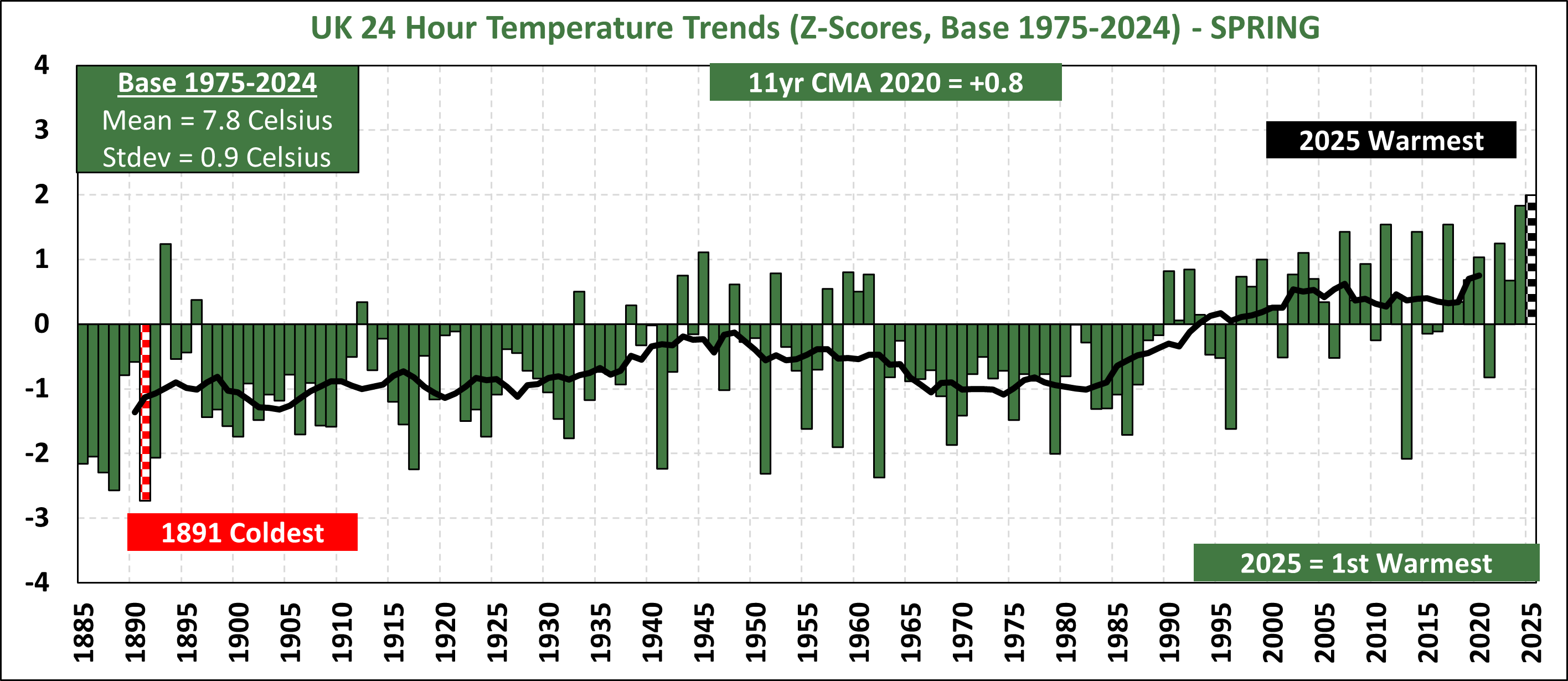


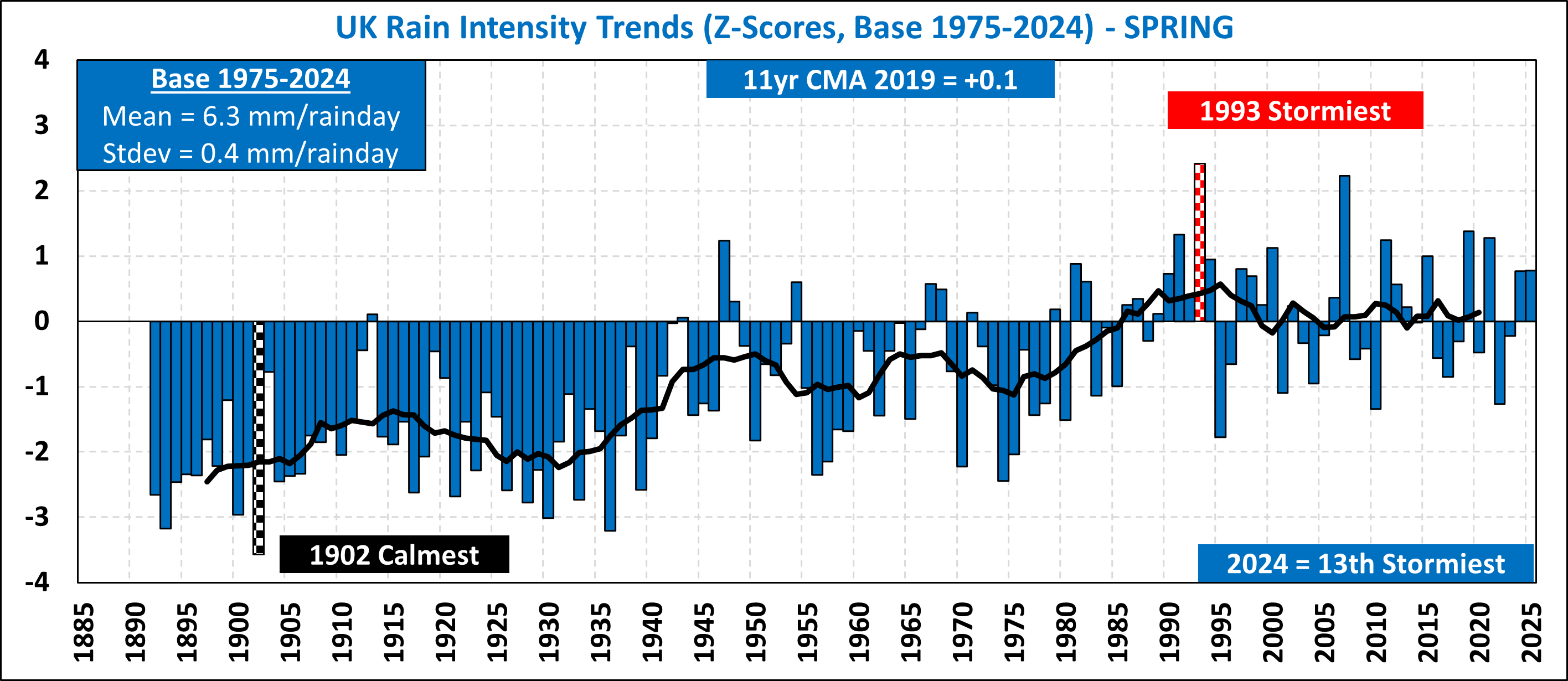
Standardised variables aid interpretation of data in many ways. If the standardised value is positive, it means that the value is above your average or expected value. If it is negative, then the value is below your expected value. If the original variable is approximately normal in its distribution then the vertical scale gives us an idea of how typical or atypical each year is. Z-Scores in the range -1 to +1 are considered typical values and completely unremarkable. Z-scores in the ranges -2 to -1 and +1 to +2 are considered to be uncommon values but still entirely plausible and such values should not cause us concern. When Z-Scores get into the ranges -3 to -2 and +2 to +3, we should start paying closer attention and asking ourselves if something has changed especially if we get a sequence of successive points in these ranges. Finally, if the Z-scores are less than -3 or greater than +3, that is normally regarded as a clear call to action.
There are in fact many ways of interpreting Z-Scores and what I have said so far merely a gives an overview of the most basic interpretations. A whole field of study known as Statistical Process Control (SPC) is dedicated to building and interpreting such charts (known as Control Charts) and you can see me use a control chart in my review of 2022 UK annual temperatures to decide if the UK was about to start a new warming phase.
For the spring of 2025, the z-scores for temperature, sunshine and rainfall were respectively +2.0, +4.9 and -2.4. This tells us the season was unusually warm and dry and exceptionally sunny. It was in fact the sunniest spring on record beating the previous record in 2020. Since I started tracking seasonal trends, this is the first time all three z-scores have had magnitudes of 2 or more.
Long Term Climate Trends
Since the 3 moving averages in the above 3 charts all use the same units, they can be plotted onto the same chart as below.

This clearly shows a shift in our spring climate over the last 100 years of 1.5 standard deviations for all 3 variables. Recall that the baseline for the z-score calculation is based on the idea of “living memory” which I have defined to be the last 50 years of 1974 to 2023. We can characterise our springs broadly as follows:
- 1885-1900 – cool and dry
- 1900-1925 – cool and normal rainfall
- 1925-1940 – cool, dry and dark
- 1940-1960 – sunny, dry and normal temperature
- 1960-1990 – cool, dark and normal rainfall.
- 1995-today – warm, sunny and normal rainfall springs.
So Spring 2025 being warm & sunny but drier than normal is still consistent with these trends. This indicates my speculation last year that springs may in fact be getting wetter may have been premature.
How many dimensions does Spring have?
The long term trends chart above suggests that the z-scores for temperature, sunshine and rainfall all appear to be correlated. In fact this can be illusory as the above chart uses moving averages. If we look at the actual z-scores, we can see what the correlations are in the 3 scatter plots below.
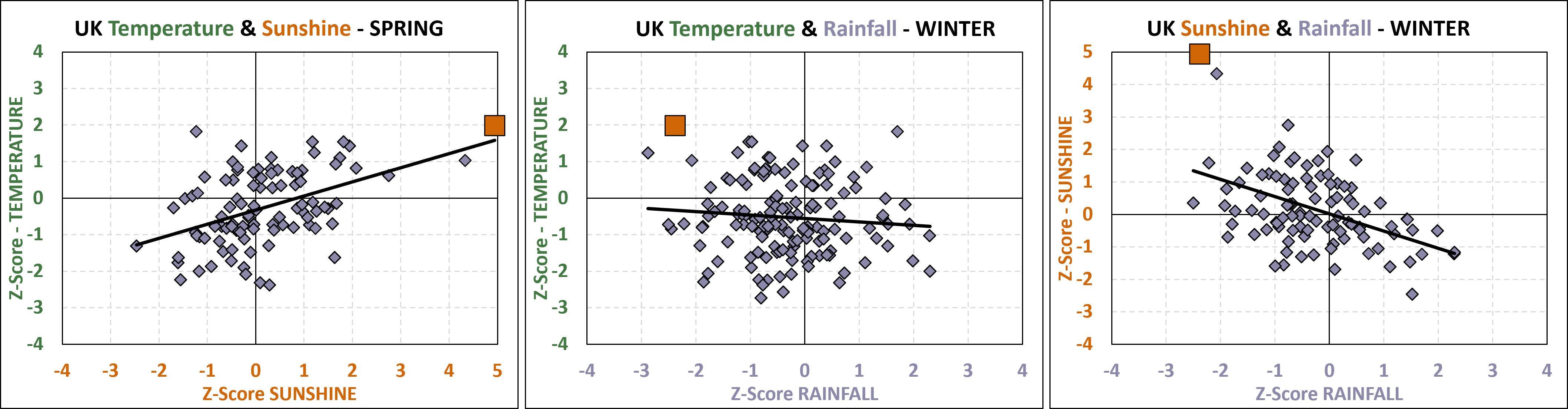
The brown square in each chart is 2025. Scatter plots can be useful to identify unusual years that do not follow the normal relationships. Unlike last spring where I speculated whether the data was correct, this year all correlations are maintained. The apparent outlier for rainfall v sunshine is due to the fact that rainfall cannot be less than zero. Given 2025 was the 5th driest on record, it’s not really possible for rainfall to be much lower even when there is so much sunshine.
Looking at the 3 scatter plots in turn, we see that temperature and rainfall is not correlated but sunshine is positively correlated with temperature and negatively correlated with rainfall. A statistician would look at these charts and observe that what appears to be 3-dimensional data (temperature, sunshine and rainfall being the 3 dimensions) is in fact closer to be being 2 dimensional. By using the method of PCA (Principal Components Analysis) which takes our 3-dimensional data set and calculates 3 new components that are statistically uncorrelated with each other, we see from the scree plot that the 1st component accounts for 1.5 dimensions whilst the 2nd component accounts for 1 dimension.

Looking at the correlation bi-plot for spring, we see that the 1st component accounts for temperature and some of sunshine, reflecting the positive correlation we see in the scatter plot above whilst the 2nd component accounts for dryness (**) and some of sunshine again reflecting the negative correlation we see in the scatter plot above. The 90 degree angle between temperature and rainfall reflects the lack of correlation between these two z-scores as we saw above.
** In the bi-plots below, rainfall has been replaced with dryness (= -1 x rainfall z-score) in spring, summer & autumn whilst winter retains rainfall. This is to aid visualisation of the biplots in terms of how the correlations change over the year. Had I used rainfall in all plots, then in the 3 seasons mentioned, the rainfall label would be on the opposite side of the circles shown.

For more information about Principal Components Analysis, please visit my link about training materials for multivariate analysis. and read the information in section A.
If you want to read my other Weather Trends posts, please click on the link or the Weather Trends hashtag below this post. Otherwise, please click the relevant season from the list below.
- 2025 – Winter, Spring, Summer, Autumn, Annual
- 2024 – Winter, Spring, Summer, Autumn, Annual
- 2023 – Winter, Spring, Summer, Autumn, Annual
- 2022 – Winter, Spring, Summer, Autumn, Annual
- 2021 – Winter, Spring, Summer, Autumn
- 2020 – Winter, Spring, Summer, Autumn
- 2019 – Winter, Spring, Summer, Autumn
- 2018 – Winter, Spring, Summer, Autumn
- 2017 – Winter, Spring, Summer, Autumn
— Subscribe to my newsletter to receive more articles like this one! —-
If you would like to receive notifications from me of news, articles and offers relating to weather, please click here to go to my Newsletter Subscription page and tick the Weather category and other categories that may be of interest to you. You will be able to unsubscribe at anytime.
