The UK weather in February was warm, wet and dark for this time of year. We also had the 2nd lowest range of temperatures on record with maximum and minimums across the 24 hours varying by only 4.5 degrees on average.
The Latest Month’s Weather in 8 Charts
The meteorological year starts in December which is why December appears as the 1st data point in the charts below. All data is supplied by the Met Office and can be found here.
I decided it was time to refresh the layout of the charts. The dashboard below now shows all 8 charts I show each as a single graphic. The middle bottom block explains why some data points are in black, points out that the charts for Sunshine & Frost are swapped around according to the seasons and how the abnormality index is calculated.
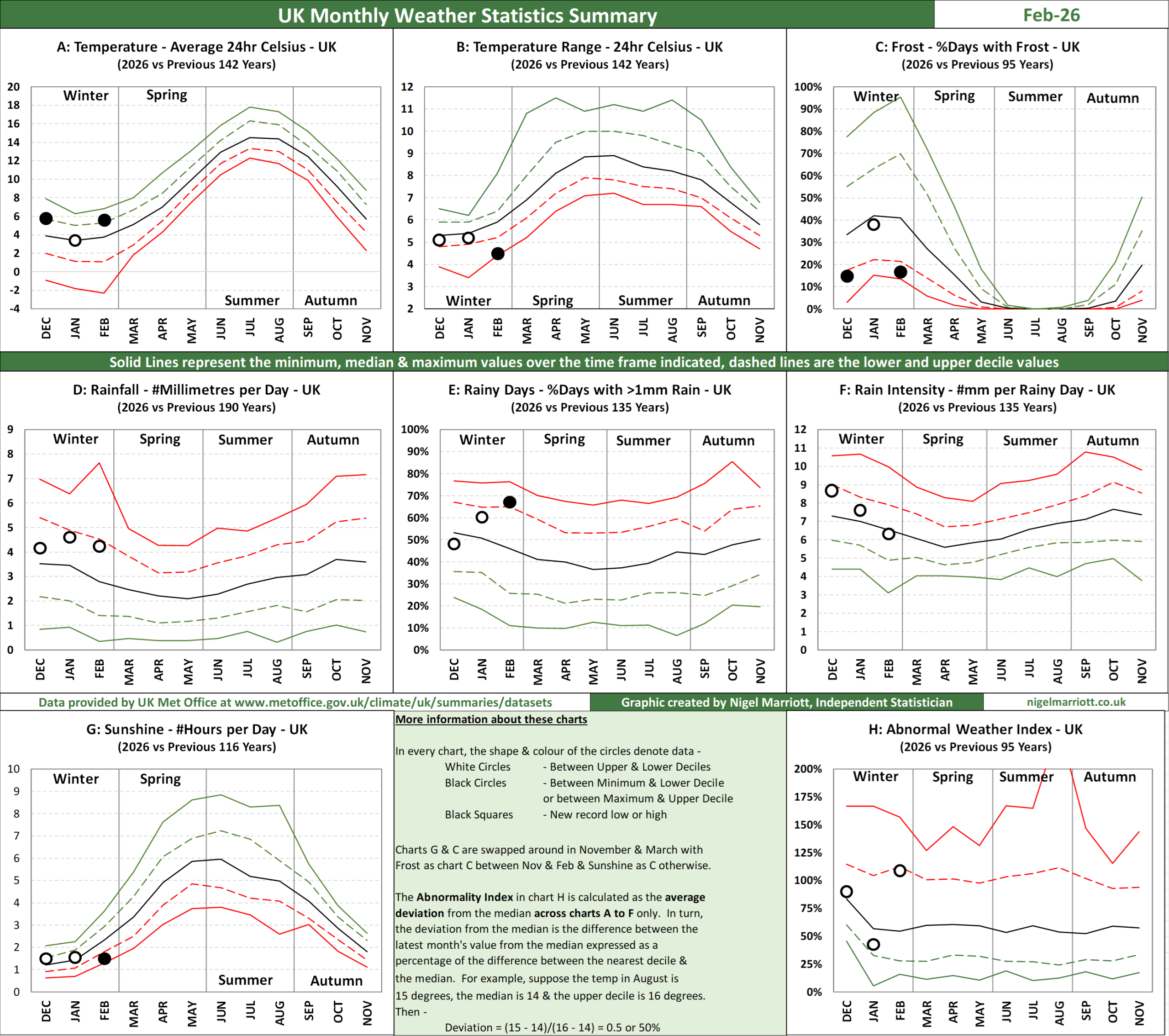
In July 2025, the Met Office extended their historical frost days data back to 1931.
How abnormal was February 2026?
Chart H displays my UK Weather Abnormality Index (see my May 2019 post for details). The closer to zero this index is, the less abnormal and thus more “average” a month is. The higher it is, the more abnormal the month is. When the index is over 100%, we can describe the month as unusual in some way.
The abnormality index was 109% this month which is equal to the upper decile of the last 95 years and makes the month unusual. This is due to the combination of warm, wet, dull and relatively uniform temperatures across the day.
Regional Variations – Winter 2026
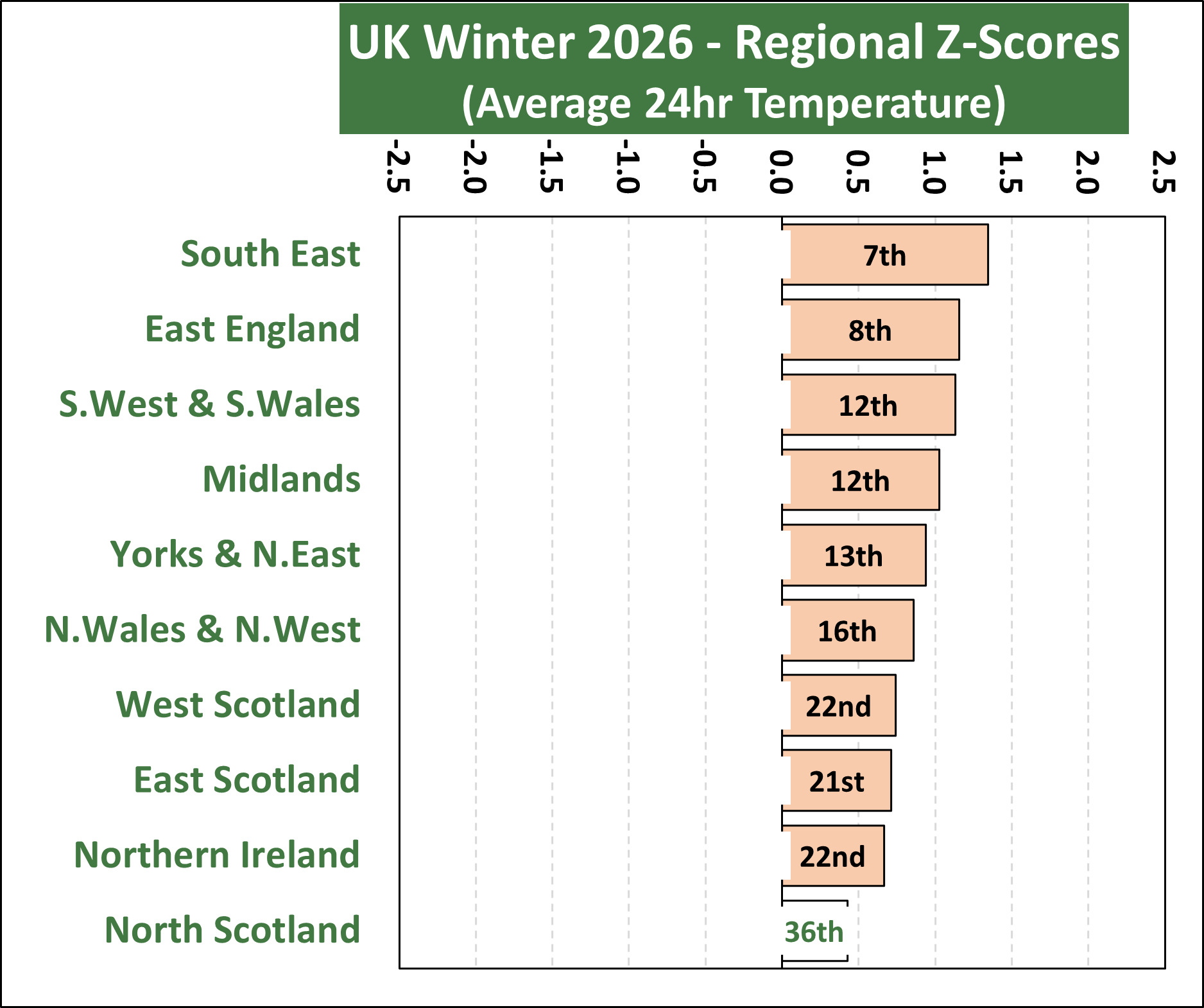 February marks the end of the meteorological winter. I do not track regional statistics every month but I do track temperature by season for each region so I can update the regional temperature chart here.
This shows the Z-Score for each region for the 2026 winter. A Z-Score is simply the regional temperature minus the long term average for that region divided by the long term standard deviation for that region. Doing this, gets around the issue of each region being different on average whereas z-scores all have the same scale, namely number of standard deviations above or below the long term average.
The 2026 winter was the 14th warmest on record nationwide. Relative to their long term averages, the South & Midlands experienced the warmest winters. For more details about the 2026 winter. click on the link provided in the list below.
PS: If you bookmark this link, it will be refreshed with the latest month’s data. I usually post the update in the first week of each month.
Click the relevant month below to see what the weather was back then. Months highlighted in bold had an abnormality index exceeding 100% indicating unusual weather. Alternatively click the Weather Tracker hash tag below this post to see a list of all such posts.
- Click here for the latest month.
- 2026 – January, February, March, April, May, June, July, August, September, October, November, December
- 2025 – January, February, March, April, May, June, July, August, September, October, November, December
- 2024 – January, February, March, April, May, June, July, August, September, October, November, December
- 2023 – January, February, March, April, May, June, July, August, September, October, November, December
- 2022 – January, February, March, April, May, June, July, August, September, October, November, December
- 2021 – January, February, March, April, May, June, July, August, September, October, November, December
- 2020 – January, February, March, April, May, June, July, August, September, October, November, December
- 2019 – January, February, March, April, May, June, July, August, September, October, November, December
- 2018 – January, February, March, April, May, June, July, August, September, October, November, December
- 2017 – January, February, March, April, May, June, July, August, September, October, November, December
For analysis of trends by seasons, please click on the relevant season from this list or the Weather Trends hashtag below this post.
- 2026 – Winter, Spring, Summer, Autumn
- 2025 – Winter, Spring, Summer, Autumn
- 2024 – Winter, Spring, Summer, Autumn
- 2023 – Winter, Spring, Summer, Autumn
- 2022 – Winter, Spring, Summer, Autumn
- 2021 – Winter, Spring, Summer, Autumn
- 2020 – Winter, Spring, Summer, Autumn
- 2019 – Winter, Spring, Summer, Autumn
- 2018 – Winter, Spring, Summer, Autumn
- 2017 – Winter, Spring, Summer, Autumn
For analysis of trends by year, please click on the relevant year from this list –
— Subscribe to my newsletter to receive more articles like this one! —-
If you would like to receive notifications from me of news, articles and offers relating to weather, please click here to go to my Newsletter Subscription page and tick the Weather category and other categories that may be of interest to you. You will be able to unsubscribe at anytime.
